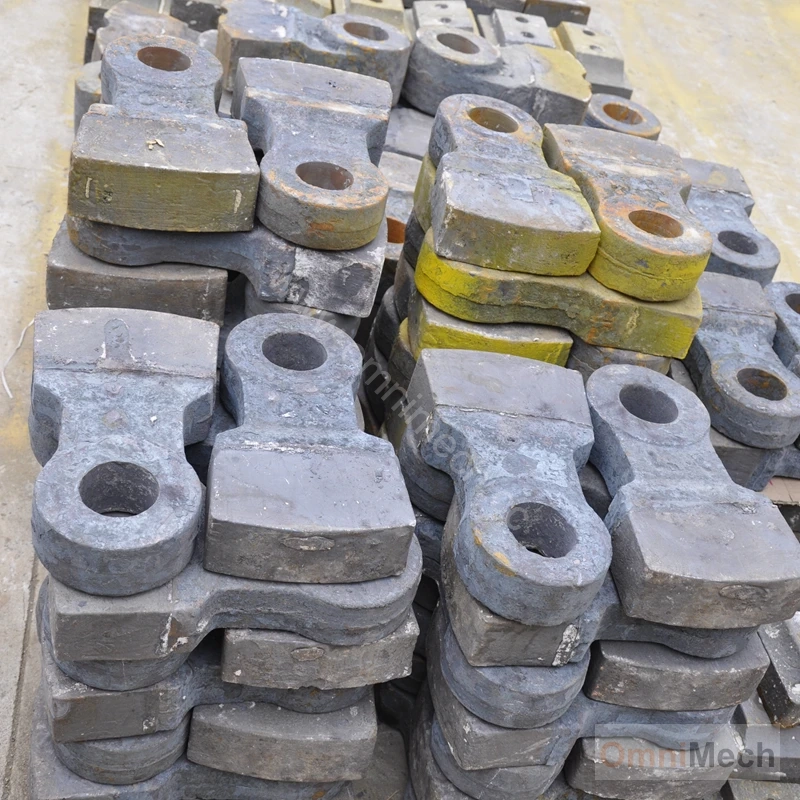
Hammer Crusher Hammers: Material Selection and Service Life Optimization
Introduction
In mining, metallurgy, building materials, and other industries, hammer crushers are commonly used crushing equipment, and the hammer as the core consumable part directly impacts the crusher’s efficiency and operating costs. Statistics show that hammer replacement costs account for over 30% of the total equipment maintenance costs. Therefore, selecting the appropriate hammer material and implementing effective usage and maintenance strategies are of great significance for reducing enterprise operating costs and improving production efficiency. This article will provide an in-depth analysis of hammer material characteristics, failure mechanisms, and optimization strategies to help you make more informed decisions.
Working Principle and Load Characteristics of Hammer Crusher Hammers
Working Principle
Hammer crushers achieve material crushing through high-speed rotating rotors that drive hammers to impact materials, utilizing impact energy for crushing. During this process, hammers bear periodic impact loads and wear effects, operating in extremely harsh environments.
Load Characteristics
Hammers mainly withstand the following types of forces during the crushing process:
Impact Force: The instantaneous impact force generated when hammers collide with materials at high speed
Wear Force: Frictional wear generated by the relative movement between materials and hammer surfaces
Shear Force: Shear action exerted by materials on hammers during the crushing process
Fatigue Stress: Material fatigue caused by long-term cyclic loading
Common Hammer Materials and Their Characteristics
High Manganese Steel Hammers
Characteristics:
High manganese steel (Mn13, Mn18) is the traditional hammer material with excellent work hardening capability
Initial hardness is relatively low (HB200-220), but under impact loads, hardness can increase to HB450-500
Good toughness and strong impact resistance
Applicable Scenarios:
Suitable for coarse crushing operations with large, high-hardness materials
Working conditions with high impact loads
Limitations:
Work hardening requires sufficient impact energy; for medium and small impact load conditions, the hardening effect is not ideal
Initial wear is relatively fast and requires a certain “running-in period”
Alloy Steel Hammers
Characteristics:
Hardness and wear resistance are improved by adding alloying elements such as chromium, molybdenum, and nickel
After heat treatment, hardness can reach HRC50-60
Balances certain toughness with wear resistance
Applicable Scenarios:
Crushing medium-hardness materials
Working conditions requiring high wear resistance
Limitations:
Relatively weaker resistance to large impact loads
Higher cost than high manganese steel
High Chromium Cast Iron Hammers
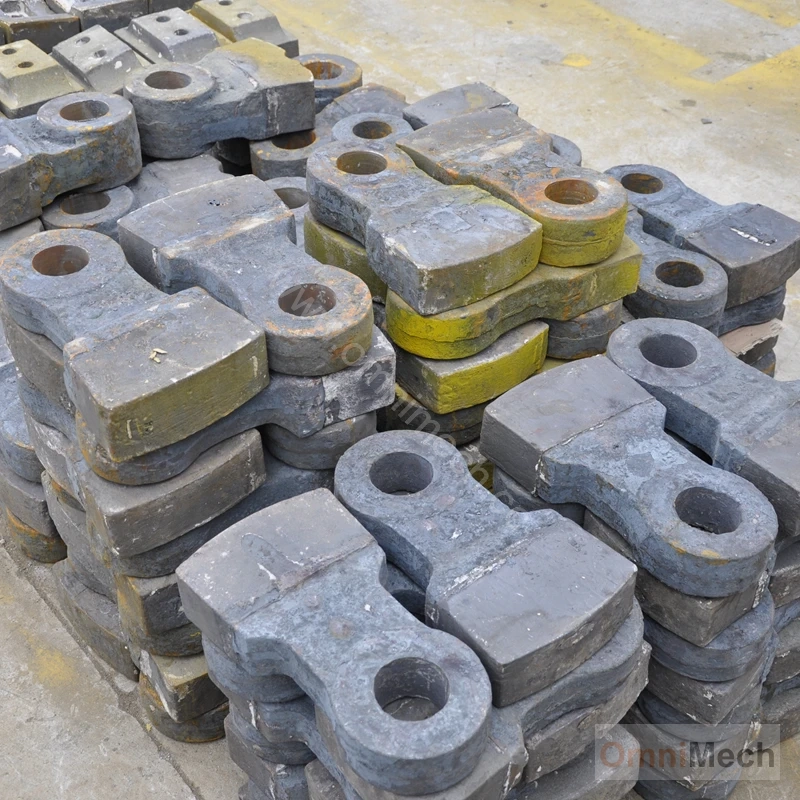
Characteristics:
Chromium content ≥12%, hardness up to HRC58-65
Excellent wear resistance, 2-3 times that of high manganese steel
Relatively brittle, weaker impact resistance
Applicable Scenarios:
Fine crushing operations, especially for materials with higher hardness and smaller particle sizes
Working conditions where wear is the primary concern with minimal impact
Limitations:
Not suitable for large impact loads
Prone to fracture failure
Composite Hammers
Characteristics:
Uses bimetal composite technology: the working part of the hammer uses high-wear-resistance material, while the hammer shank uses high-toughness material
Balances wear resistance and impact resistance
Service life is 30%-50% longer than single-material hammers
Applicable Scenarios:
Complex working conditions with both impact and wear concerns
Scenarios with high service life requirements
Advantages:
- Excellent comprehensive performance and high cost-effectiveness
Analysis of Hammer Failure Modes
Wear Failure
Wear failure is the primary failure mode for hammers, accounting for 60%-70% of all failures. Main manifestations include:
Working surface gradually thinning
Edges wearing to form rounded corners
Reduced mass and declining crushing efficiency
Fracture Failure
Fracture failure mainly occurs in brittle material hammers such as high chromium cast iron, with causes including:
Internal material defects (gas holes, slag inclusions, etc.)
Excessive impact loads
Improper heat treatment processes
Deformation Failure
For materials with lower hardness, plastic deformation may occur, causing the hammer shape to change and affecting crushing efficiency.
Hammer Selection Guide
Selection Based on Material Characteristics
| Material Characteristics | Recommended Material | Explanation |
|---|---|---|
| Large high-hardness ore | High manganese steel | Utilizes work hardening characteristics |
| Medium-hardness materials | Alloy steel | Balances wear resistance and toughness |
| Fine crushing with small particles | High chromium cast iron | Maximizes high wear resistance |
| Complex working conditions | Composite hammer | Optimal comprehensive performance |
Selection Based on Crushing Process
Coarse Crushing: Prioritize high manganese steel or composite hammers, focusing on impact resistance
Medium Crushing: Alloy steel hammers are the ideal choice
Fine Crushing: High chromium cast iron hammers provide the best wear resistance
Cost-Benefit Analysis
Although the initial procurement cost of high chromium cast iron hammers is higher, considering their service life is 2-3 times that of high manganese steel, the comprehensive operating cost is actually lower. Enterprises should conduct full lifecycle cost analysis during selection, not just look at procurement prices.
Strategies for Extending Hammer Service Life
Optimizing Design
Reasonably Design Hammer Shape: Optimize the geometric shape of the working surface for more uniform material impact
Improve Fixation Method: Use reliable fixation structures to avoid abnormal wear caused by hammer loosening
Optimize Rotor Balance: Reduce additional impact on hammers caused by vibration
Proper Usage
Control Feed Size: Avoid oversized materials causing excessive impact on hammers
Maintain Uniform Feeding: Keep feeding continuous and uniform to prevent hammer overload
Timely Adjustment: When uneven hammer wear is detected, promptly adjust positions
Maintenance and Care
Regular Inspection: Establish a regular inspection system to promptly discover and replace severely worn hammers
Complete Set Replacement: It is recommended to replace hammers in complete sets to maintain rotor balance
Record and Analysis: Record hammer service life data, analyze failure causes, and continuously optimize
Preventive Maintenance
Based on historical usage data, predict hammer replacement cycles and perform preventive replacement before failure occurs to avoid equipment damage caused by hammer fractures.
Industry Development Trends
New Material Applications
Ceramic Composite Materials: Adding ceramic particles to metal substrates to significantly improve wear resistance
Nanomaterials: Using nanotechnology to improve mechanical properties of materials
Surface Engineering Technologies: Extending service life through surface treatment technologies such as welding and spraying
Intelligent Monitoring
Online monitoring of hammer wear status
Predicting remaining hammer life based on big data
Intelligent warning systems for advance maintenance reminders
Green Manufacturing
Using environmentally friendly materials and processes
Improving material recycling rates
Reducing energy consumption and emissions during manufacturing
Summary and Action Recommendations
Summary
The selection and use of hammer crusher hammers directly affect enterprise production efficiency and operating costs. High manganese steel, alloy steel, high chromium cast iron, and composite hammers each have their own advantages and disadvantages. Enterprises should make comprehensive selections based on material characteristics, crushing processes, and cost-benefit analysis. By optimizing design, proper usage, and maintenance, hammer service life can be significantly extended and comprehensive costs reduced.
Action Recommendations
If your enterprise is facing frequent hammer replacements and high costs, it is recommended that you:
Analyze whether the hammer material currently in use matches the working conditions
Evaluate the application potential of composite hammers
Establish a comprehensive usage and maintenance system
Consider introducing intelligent monitoring technology to achieve preventive maintenance
Want to learn more specific recommendations for hammer selection? Feel free to contact our technical team for personalized solutions.
FAQ
How long do hammer crusher hammers typically last?
Hammer service life varies depending on working conditions, generally ranging from 1-3 months. High chromium cast iron hammers can last 3-6 months in fine crushing conditions, while high manganese steel hammers may only last 1-2 months when crushing large lump materials.
How to determine if hammers need replacement?
Consider replacement when the following occurs: 1) Hammer wear exceeds 30% of original weight; 2) Severe cracks appear on the working surface; 3) Crushing efficiency significantly declines; 4) Severe hammer deformation.
Why do my hammers frequently fracture?
Hammer fractures are usually caused by improper material selection (brittle materials subjected to large impacts), internal defects, overload, or insecure fixation. It is recommended to check whether the material matches the working conditions and optimize the usage process.
Is investing in composite hammers worthwhile?
Although the initial cost of composite hammers is higher, their service life is typically 30%-50% longer than single-material hammers, making comprehensive operating costs lower. They are a worthwhile investment for enterprises pursuing long-term benefits.
How to improve hammer service life?
The key to extending hammer service life lies in: reasonable selection, proper usage, and regular maintenance. This specifically includes controlling feed size, maintaining uniform feeding, regular inspection, and complete set replacement. Additionally, adopting new materials and processes is also an effective approach.
Tags:
OmniMech Technical Team
Technical expert at Crusher Parts International with years of experience in the crushing and mining industry.