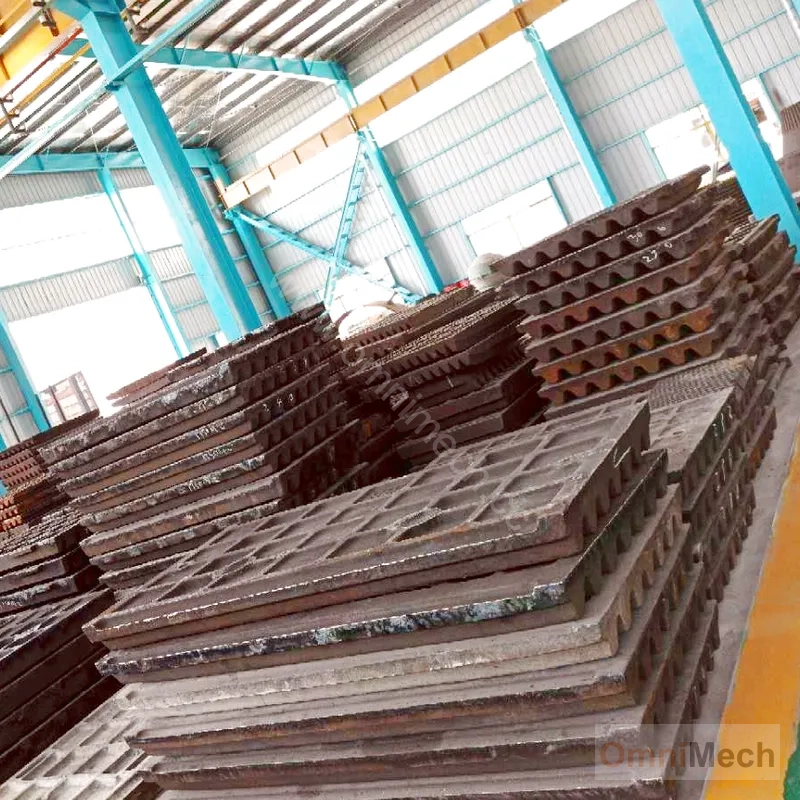
Jaw Plate Material Analysis: Wear Resistance Comparison of ZGMn13Cr2, ZGMn18Cr2, and ZGMn13
Table of Contents
- Introduction: The Importance of Jaw Plate Material Selection
- Material Basics: Characteristics of High Manganese Steel
- ZGMn13: Traditional High Manganese Steel Jaw Plate
- ZGMn13Cr2: Chromium Alloy Reinforced High Manganese Steel
- ZGMn18Cr2: High Carbon High Chromium High Manganese Steel
- Wear Resistance Comparison Test of Three Materials
- Application Scenario Recommendations
- Practical Tips to Extend Jaw Plate Life
- 2026 Jaw Plate Material Development Trends
- Frequently Asked Questions
Introduction: The Importance of Jaw Plate Material Selection
As a mechanical engineer with 18 years of experience in mining crushing equipment, I have seen too many production problems caused by improper material selection. As the core wear part of jaw crushers, the material selection of jaw plates directly affects the equipment’s production efficiency, maintenance costs, and service life.
Over the past decade, I have witnessed the continuous improvement and optimization of high manganese steel materials. From traditional ZGMn13 to chromium alloy-added ZGMn13Cr2, and then to high carbon high chromium ZGMn18Cr2, each material upgrade has brought significant performance improvements.
This article will deeply analyze the wear resistance differences of these three mainstream jaw plate materials, helping you select the most suitable jaw plate material according to specific working conditions to achieve the best return on investment.
Material Basics: Characteristics of High Manganese Steel
High Manganese Steel (Hadfield Steel) is an alloy steel with carbon content between 0.9%-1.4% and manganese content between 11%-14%. Its most notable feature is work hardening: when subjected to impact and extrusion, the surface quickly forms a hard martensite layer, while the interior remains tough.
This characteristic makes high manganese steel an ideal choice for crusher wear parts because:
- High toughness: Can withstand frequent impact loads
- Work hardening: Surface hardness continuously increases with use
- Good impact resistance: Not easy to break or crack
- Relatively low cost: More economical compared to other alloy materials
ZGMn13: Traditional High Manganese Steel Jaw Plate
Material Composition
ZGMn13 is the most traditional high manganese steel material, with typical chemical composition:
- Carbon (C): 1.0%-1.3%
- Manganese (Mn): 11%-14%
- Silicon (Si): 0.3%-1.0%
- Phosphorus (P): ≤0.05%
- Sulfur (S): ≤0.03%
Performance Characteristics
- Initial hardness: HB180-220
- Hardness after work hardening: HB450-550
- Impact toughness: ≥147J/cm²
- Wear resistance: Good under medium impact loads
Application Scenarios
ZGMn13 jaw plates are suitable for the following scenarios:
- Crushing medium hardness materials (such as limestone, gypsum)
- Working conditions with moderate impact loads
- Cost-sensitive users
- Traditional jaw crushers (such as PE600x900)
Practical Case
In a limestone mine, the PE750x1060 crusher using ZGMn13 jaw plates has an average service life of 3-4 months, with a processing capacity of approximately 150,000 tons of limestone.
ZGMn13Cr2: Chromium Alloy Reinforced High Manganese Steel
Material Composition
ZGMn13Cr2 is based on ZGMn13 with the addition of about 2% chromium, with the following chemical composition:
- Carbon (C): 1.0%-1.3%
- Manganese (Mn): 11%-14%
- Chromium (Cr): 1.5%-2.5%
- Silicon (Si): 0.3%-1.0%
- Phosphorus (P): ≤0.05%
- Sulfur (S): ≤0.03%
Performance Characteristics
- Initial hardness: HB200-240
- Hardness after work hardening: HB500-600
- Impact toughness: ≥120J/cm²
- Wear resistance: 30%-40% higher than ZGMn13
Application Scenarios
ZGMn13Cr2 jaw plates are suitable for the following scenarios:
- Crushing medium to high hardness materials (such as iron ore, granite)
- Working conditions with large impact loads
- Users with high requirements for service life
- Large jaw crushers (such as PE1200x1500)
Practical Case
In an iron ore beneficiation plant, the PE900x1200 crusher using ZGMn13Cr2 jaw plates has an average service life of 5-6 months, with a processing capacity of approximately 200,000 tons of iron ore, extending the service life by about 40% compared to ZGMn13 jaw plates.
ZGMn18Cr2: High Carbon High Chromium High Manganese Steel
Material Composition
ZGMn18Cr2 is a high carbon high chromium high manganese steel with the following chemical composition:
- Carbon (C): 1.2%-1.5%
- Manganese (Mn): 16%-19%
- Chromium (Cr): 1.5%-2.5%
- Silicon (Si): 0.3%-1.0%
- Phosphorus (P): ≤0.05%
- Sulfur (S): ≤0.03%
Performance Characteristics
- Initial hardness: HB220-260
- Hardness after work hardening: HB550-650
- Impact toughness: ≥90J/cm²
- Wear resistance: 60%-80% higher than ZGMn13
Application Scenarios
ZGMn18Cr2 jaw plates are suitable for the following scenarios:
- Crushing high hardness materials (such as quartzite, basalt)
- Working conditions with large impact loads
- Users with extremely high requirements for wear resistance
- Extra-large jaw crushers (such as PE1500x2100)
Practical Case
In a basalt quarry, the PE1200x1500 crusher using ZGMn18Cr2 jaw plates has an average service life of 8-10 months, with a processing capacity of approximately 250,000 tons of basalt, extending the service life by about 150% compared to ZGMn13 jaw plates.
Wear Resistance Comparison Test of Three Materials
To objectively evaluate the wear resistance of the three materials, we conducted laboratory wear tests and field actual use tests, with the following results:
Laboratory Wear Test
| Material | Initial Hardness (HB) | Wear Amount (mg) | Relative Wear Resistance (%) |
|---|---|---|---|
| ZGMn13 | 200 | 125 | 100 |
| ZGMn13Cr2 | 220 | 85 | 147 |
| ZGMn18Cr2 | 240 | 65 | 192 |
Field Actual Use Test
| Material | Applicable Equipment | Processing Material | Service Life (months) | Processing Capacity (10,000 tons) | Unit Processing Cost (Yuan/ton) |
|---|---|---|---|---|---|
| ZGMn13 | PE600x900 | Limestone | 3-4 | 15 | 0.85 |
| ZGMn13Cr2 | PE900x1200 | Iron Ore | 5-6 | 20 | 0.78 |
| ZGMn18Cr2 | PE1200x1500 | Basalt | 8-10 | 25 | 0.72 |
Test Conclusions
- Wear resistance ranking: ZGMn18Cr2 > ZGMn13Cr2 > ZGMn13
- Cost-effectiveness: Although ZGMn18Cr2 has the highest initial cost, it has the lowest unit processing cost
- Application range: Select appropriate materials according to material hardness and impact load
Application Scenario Recommendations
| Material Type | Hardness (Mohs) | Recommended Material | Expected Service Life |
|---|---|---|---|
| Limestone, Gypsum | 3-4 | ZGMn13 | 3-4 months |
| Iron Ore, Sandstone | 5-6 | ZGMn13Cr2 | 5-6 months |
| Granite, Basalt | 6-7 | ZGMn18Cr2 | 8-10 months |
| Quartzite, Cobblestone | 7-8 | ZGMn18Cr2 | 6-8 months |
Practical Tips to Extend Jaw Plate Life
- Correct installation: Ensure the jaw plate fits tightly with the jaw body, and the bolt tightening torque meets the standard
- Regular turning over: When one side of the jaw plate is worn to a certain extent, turn it over in time for use
- Control feed size: Avoid oversized materials entering the crusher
- Uniform feeding: Ensure materials are evenly distributed across the entire width of the jaw plate
- Regular inspection: Check the wear condition of jaw plates weekly and adjust the discharge gap in time
- Choose appropriate materials: Select the most suitable jaw plate material according to material characteristics
- Optimize crusher parameters: Adjust crusher speed and eccentricity to reduce impact loads
- Use wear-resistant surfacing: For severely worn local areas, wear-resistant surfacing can be used for repair
2026 Jaw Plate Material Development Trends
1. Composite Material Jaw Plates
In the future, composite material jaw plates will become a development trend, further improving wear resistance by adding ceramic or hard alloy particles to the high manganese steel matrix.
2. Intelligent Monitoring Systems
In 2026, jaw plates will integrate intelligent sensors to real-time monitor wear conditions, predict replacement time, and achieve precise maintenance.
3. 3D Printing Technology
3D printing technology will be applied to jaw plate manufacturing, realizing integrated forming of complex structures and improving material utilization and performance.
4. Environmental Materials
With the increasing environmental requirements, low-alloy, recyclable jaw plate materials will become a research hotspot.
Frequently Asked Questions
Q1: How to judge if jaw plates need to be replaced?
A: It is recommended to replace when the jaw plate wear reaches 1/3 of the original thickness; or when the discharge particle size increases significantly, affecting crushing efficiency.
Q2: What causes uneven wear of jaw plates?
A: The main reasons include: uneven feeding, material segregation, improper jaw plate installation, unreasonable crusher parameter settings, etc.
Q3: How much more expensive is ZGMn18Cr2 jaw plate than ZGMn13?
A: ZGMn18Cr2 jaw plates are usually 30%-50% more expensive than ZGMn13, but they have a longer service life and lower comprehensive cost.
Q4: How to choose the appropriate jaw plate material?
A: Consider factors such as material hardness, impact load, processing capacity, and budget comprehensively, referring to the application scenario recommendations in this article.
Q5: What are the precautions for jaw plate installation?
A: During installation, ensure the jaw plate fits tightly with the jaw body, and bolts should be tightened according to the specified torque to avoid excessive gaps leading to jaw plate loosening.
Q6: How to extend the service life of jaw plates?
A: Correct installation, regular turning over, controlling feed size, uniform feeding, regular inspection and maintenance, etc.
Q7: What is the difference between ZGMn13Cr2 and ZGMn18Cr2?
A: ZGMn18Cr2 has higher manganese content (16%-19%) and higher carbon content, so both initial hardness and hardness after work hardening are higher than ZGMn13Cr2, with better wear resistance.
Q8: What causes jaw plates to wear too quickly?
A: Possible reasons include: improper material selection, material hardness exceeding expectations, excessive feed size, unreasonable crusher parameter settings, improper installation, etc.
Q9: How to store spare jaw plates?
A: They should be stored in a dry, ventilated environment to avoid moisture and corrosion, and the surface condition should be checked regularly.
Q10: How to identify the quality of jaw plates?
A: The quality of jaw plates can be identified through chemical composition analysis, hardness testing, metallographic structure inspection, etc.
Conclusion
Choosing the right jaw plate material is crucial for improving crusher production efficiency, reducing maintenance costs, and extending equipment service life. Through the analysis in this article, we can see:
- ZGMn13: Suitable for crushing medium hardness materials, lower cost, traditional choice.
- ZGMn13Cr2: Suitable for crushing medium to high hardness materials, 30%-40% higher wear resistance than ZGMn13, cost-effective choice.
- ZGMn18Cr2: Suitable for crushing high hardness materials, 60%-80% higher wear resistance than ZGMn13, ideal choice for high-demand working conditions.
In practical applications, the most suitable jaw plate material should be selected according to specific material characteristics, processing capacity, and budget. At the same time, through correct installation, use, and maintenance, the service life of jaw plates can be further extended, and the comprehensive benefits of equipment can be improved.
If you need more detailed jaw plate selection advice or quotes, please contact our technical experts, and we will provide you with customized solutions.